Imagine sitting at a lively dinner table with family or coworkers. The room is filled with background music, clinking silverware, and casual chatter. People around you laugh and chat effortlessly. However, you are straining with every bit of mental energy to catch every third word. You nod along, guessing from context, worn out by the mental effort of listening.
Desperate for answers, you schedule a hearing test. The clinician plays a series of quiet beeps in a soundproof room, hands you the results, and says, “Good news! Your hearing is completely normal.” Instead of feeling relieved, you feel defeated. If your hearing is “normal,” why is communicating in the real world so agonizingly difficult?
If this story sounds familiar, you are not imagining things, and you are not alone. Millions of people experience what is clinically known as hidden hearing loss (cochlear synaptopathy), Auditory Processing Disorder (APD), or listening difficulties associated with neurodivergence and traumatic brain injury.
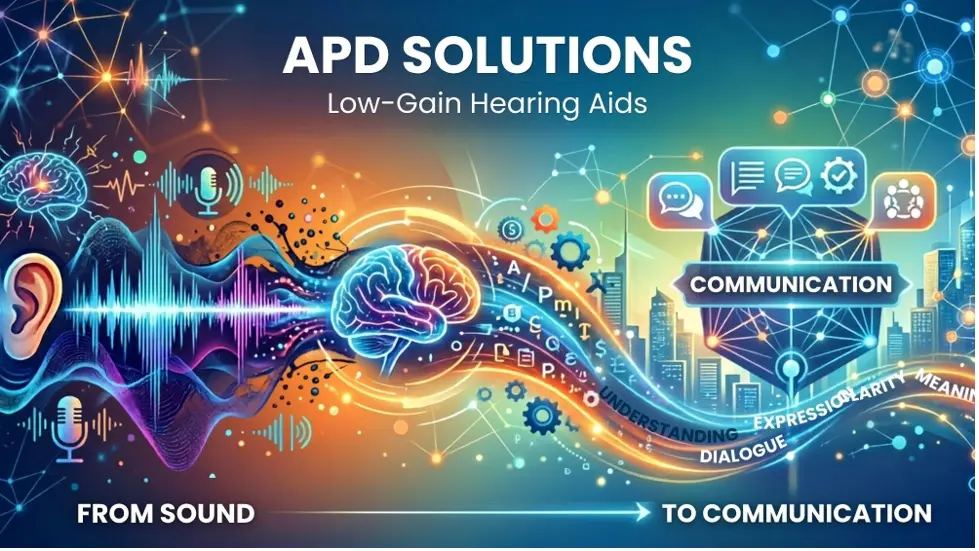
In our practice, we specialize in solving this puzzle. By combining low-gain hearing aids (LGHAs) with precise, objective fitting protocols and specialized ancillary services, we help individuals with normal pure-tone hearing regain clear communication and confidence. Our diagnostic services and personalized treatment approaches go beyond what you would find at traditional audiology clinics or with hearing instrument specialists, who are limited in their ability to address these complex APD cas
How Low-Gain Hearing Aids Can Help With APD
Low-gain hearing aids differ from conventional hearing aids prescribed for significant hearing loss. Traditional amplification primarily increases access to sounds that are too soft to hear. A low-gain fitting provides much less amplification and uses the processing capabilities of modern hearing technology to support speech access.
For selected individuals with normal pure-tone hearing, low-gain programming may typically involve approximately 5–15 decibels of gain, depending on the person’s auditory profile and clinical needs. The appropriate level must be determined individually rather than applied as a standard setting.
Supporting Speech in Background Noise
One of the most important features of low-gain technology is its ability to improve the relationship between speech and competing sound.
Directional microphones can focus on the person speaking in front of the listener while reducing the influence of sounds from other directions. This can be useful when several people are talking or when environmental noise makes it difficult to identify the primary speaker
Digital noise-reduction systems can also help manage certain continuous background sounds, such as HVAC noise, traffic, or restaurant noise. The result is not silence. Instead, the hearing aid can reduce competing acoustic information while keeping speech available to the listener.
Providing Subtle Speech Support
Low-gain programming can provide modest support to important speech frequencies without applying the level of amplification used for a conventional hearing loss.
This distinction is important for people whose hearing thresholds are within normal limits. Applying a traditional hearing-aid prescription in this situation could provide more amplification than necessary, making environmental sounds uncomfortable or unnatural. Specialized programming allows the audiologist to control the amount and frequency of amplification more precisely.
Choosing the Right Hearing Aid
The device’s physical design also matters. An open-fit Receiver-in-Canal (RIC) hearing aid may be appropriate for some individuals with normal hearing because the open dome allows natural low-frequency sounds to enter the ear. At the same time, the device provides targeted processing and amplification.
Technology selection should also consider directional microphones, noise reduction, speech-processing features, wireless connectivity, remote-microphone compatibility, comfort, lifestyle, and the environments where communication is most challenging.
We work with multiple hearing technology manufacturers so we can select a device tailored to the individual’s needs, rather than expecting every patient to use the same technology.
Our APD Treatment Process with Log-Gain Hearing Aids
Step 1: Comprehensive APD Evaluation
Before recommending low-gain hearing aids, we need to understand what makes listening difficult.
At Audiology & Speech Solutions, the process begins with the patient’s intake questionnaire, family and medical history, hearing history, previous evaluations, and a discussion of the most challenging communication situations. A comprehensive APD evaluation typically takes two to three hours and may include evidence-based auditory processing measures and elements of the Buffalo Model.
Depending on the clinical question, testing may assess skills such as speech understanding in noise, dichotic listening, auditory memory, temporal processing, and other auditory functions.
The results provide the information needed to determine whether low-gain amplification is appropriate and which features would be most useful.
Step 2: Specialized Programming
Low-gain hearing aids require a different approach than a conventional hearing-aid fitting. Automatic first-fit software is generally designed for individuals with hearing loss. Applying those settings to someone with normal hearing can unnecessarily amplify environmental sounds.
We carefully adjust the device to match the patient’s hearing thresholds, auditory processing profile, communication needs, and comfort. During the fitting, I tailor gain, frequency response, directional settings, noise reduction, and other available features.
Step 3: Real-Ear Measurement (REM)
REM allows us to verify what the hearing aid is actually delivering in the patient’s ear.
A thin probe tube is placed in the ear canal while calibrated speech signals are presented. The hearing aid’s output can then be measured and adjusted rather than relying solely on the manufacturer’s default settings.
For a low-gain fitting, this objective verification is especially useful because amplification is intentionally limited. The fitting material specifies verification at key speech frequencies and a target gain range of approximately 5–15 dB.
Step 4: Follow-Up and Adjustment
The fitting continues after the hearing aids are dispensed. Patients may notice differences between listening in the office and in everyday settings such as work, school, restaurants, family gatherings, and other environments.
Follow-up appointments offer an opportunity to discuss those experiences, fine-tune the devices, review communication strategies, and determine whether additional support would be helpful. Ongoing follow-up and auditory rehabilitation are integral to the clinic’s approach to APD management.
Building a Stronger Communication Strategy
Low-gain hearing aids can be an important part of an APD management plan. Additional services can build on the technology by addressing listening skills, communication habits, and the environments in which the person needs to function.
Auditory Training
Auditory training provides structured practice in specific listening skills. Depending on the patient’s needs, computerized programs can target auditory memory, auditory closure, processing speed, and the ability to follow a target voice while competing voices are present.
This type of practice allows patients to work directly on the auditory skills identified during their evaluation. Select the specific program and schedule based on the individual’s needs rather than using a one-size-fits-all solution.
Wireless Remote Microphone Technology
Even with carefully fitted hearing aids, distance can still affect speech access. A remote microphone can be placed near the primary speaker and transmit that person’s voice directly to compatible hearing devices.
This can be especially useful for students listening to a teacher, professionals in meetings, or adults attending lectures and other large gatherings.
Communication Strategies
Technology works particularly well when patients know how to use their listening environment to their advantage.
Positioning yourself closer to the primary speaker, choosing a quieter area of a restaurant, and ensuring you can see the speaker’s face can all be helpful. Communication partners can also help by rephrasing an important statement rather than simply repeating the same words.
These small adjustments can make a meaningful difference in situations where listening conditions change rapidly.
Environmental Counseling
Not every listening environment places the same demands on the auditory system. A quiet office conversation differs greatly from those in a crowded restaurant or an open-plan workplace.
Environmental counseling helps patients identify the conditions that make communication easier and develop practical strategies for the places where they spend the most time. It can also help families, teachers, and coworkers understand how to create more supportive communication environments.
Rediscovering the Ease of Conversation
When low-gain hearing aids are appropriately selected, precisely fitted, and paired with supportive services, the difference may show up in everyday moments rather than in a dramatic before-and-after test.
A conversation with a spouse may be easier to follow. A meeting may require less concentration. Dinner with friends may become more enjoyable because you are spending less energy trying to figure out what was said.
For some patients, these changes can also mean becoming more willing to participate in situations they previously found exhausting. Instead of sitting quietly because following the conversation feels overwhelming, they may feel more comfortable joining in.
That is what makes this work meaningful to us. We are not interested in simply placing a device on someone’s ears. I want to understand why communication is difficult and determine which combination of technology, auditory training, and practical strategies can best support that individual.
Better communication is about more than hearing every sound. It is about being able to participate in the conversations that matter to you.
Take the Next Step
If you have been told your hearing is normal but still struggle to understand speech, especially in noisy or complex environments, an Auditory Processing Disorder evaluation can help identify the specific listening difficulties you face.
At Audiology & Speech Solutions, we take the time to understand your auditory profile, communication needs, and the most challenging situations. When low-gain hearing aids are appropriate, I combine individualized technology selection, specialized programming, Real-Ear Measurement, follow-up, and complementary auditory rehabilitation services.
You don’t have to accept that conversations will always be draining.
Let’s find out what is making listening difficult and what we can do to improve communication.
Audiology & Speech Solutions
350 Theodore Fremd Ave.
Rye, NY 10580
📞 Phone: 914-588-8088
✉️ Email: info@audiology-speech.com
🌐 Website: www.audiology-speech.com