
The Frustrating Reality Nobody Talks About
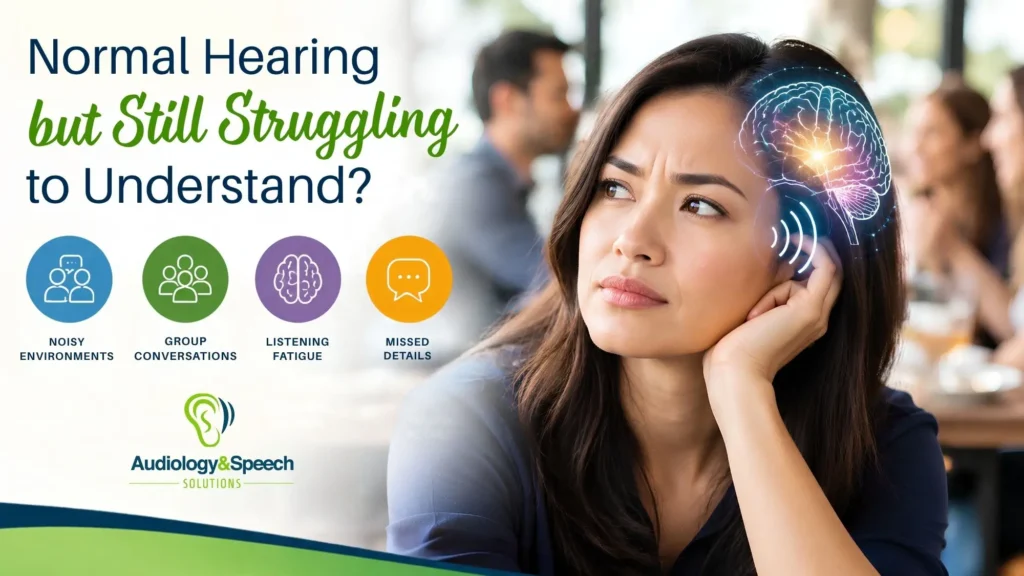
Have you ever left a hearing test relieved that your hearing was normal but frustrated because your daily communication problems were still there? You struggle to understand conversations in restaurants, family members seem to mumble, meetings are exhausting, and group discussions move too fast. Yet you are told your hearing is normal.
Many patients begin to question themselves. They wonder whether they are distracted, aging poorly, or simply not paying enough attention. The truth is that hearing and communication are far more complex than most people realize. A traditional audiogram measures how softly sounds must be presented before you can detect them. It often does not measure how effectively your brain processes and interprets those sounds in real-world environments.
That distinction matters. Real life does not happen in a quiet sound booth. It happens in noisy restaurants, crowded family gatherings, busy workplaces, houses of worship, classrooms, and community events. Success in those situations depends on much more than the ability to hear a beep.
Normal Hearing yet Struggling to Listen
Millions of people experience a frustrating mismatch between their test results and their everyday reality. They can hear sounds but struggle to understand speech. They may miss parts of conversations, misunderstand instructions, struggle to understand speakers with accents, or feel mentally exhausted after social interactions.
Communication requires multiple systems to work together. Your ears must detect sound, but your brain must also organize, filter, prioritize, and interpret that information. When auditory processing is weak, patients can face significant communication challenges even when hearing sensitivity appears normal.
Common symptoms include difficulty understanding speech in background noise, frequent requests for repetition, trouble following rapid conversation, poor listening stamina, difficulty remembering spoken information, and increased listening fatigue. These challenges can extend far beyond hearing itself.
Relationships often suffer when communication becomes difficult. Family members may assume a loved one is not paying attention. Patients may withdraw from social situations because participation feels too difficult. At work, communication challenges can affect productivity, confidence, and professional performance. Over time, many patients lose confidence because they don’t understand why communication feels harder for them than it seems for everyone else.
Unfortunately, many traditional audiology practices focus primarily on identifying hearing loss and fitting hearing aids. While those services are extremely valuable, they do not always answer the fundamental question a patient is asking: Why am I struggling to communicate?
Your Hearing Test Isn’t the Whole Story
If this sounds familiar, we want you to know something important: we believe you.
Communication difficulties are real even when hearing thresholds are normal. Patients often arrive in our office feeling discouraged because previous evaluations have not provided answers. Some have been told that everything looks fine. Others have been reassured that everyone struggles in noisy environments. While those statements may be well-intentioned, they rarely address the patient’s daily frustrations.
We understand how discouraging it can be to know something is wrong but not be able to explain it. We understand how exhausting it can be to work harder than everyone else to follow a conversation. We understand the embarrassment that can accompany repeated misunderstandings and the isolation that often develops when social situations become overwhelming.
Most importantly, we understand that communication problems deserve investigation. A normal hearing test should not automatically end the conversation. Instead, it should begin a broader effort to identify what factors may be affecting communication success.
Every patient deserves answers, respect, and a provider willing to look beyond basic screening results. That philosophy drives everything we do.
We Find What Others Miss
What differentiates our practice is our commitment to evaluating the entire communication system, not just hearing thresholds.
A traditional audiogram provides valuable information, but it represents only one piece of a much larger puzzle. Our comprehensive approach seeks to understand how patients function in the real world. We evaluate not just whether patients hear sound, but how effectively they understand and use auditory information.
Depending on patient needs, our assessments may include speech understanding in noise testing, auditory processing evaluations, listening effort assessments, communication needs analyses, and other specialized measures that help reveal issues not visible on a standard hearing test.
Speech-in-noise testing is particularly valuable because background noise is where many patients experience their greatest difficulties. Someone may perform well in a quiet room but struggle significantly when competing sounds are present. Identifying that challenge can explain years of frustration.
Auditory processing assessments can provide additional insight into how the brain handles spoken information. Difficulties involving auditory attention, auditory memory, processing speed, auditory discrimination, and other listening functions may contribute to communication breakdowns.
We also recognize that effective listening involves cognitive resources such as attention and working memory. Communication difficulties frequently arise from the interaction of auditory and cognitive demands. By taking a broader perspective, we can often identify contributing factors that would otherwise remain hidden.
Unlike practices whose services end with the audiogram, our goal is to uncover the true source of communication difficulty and provide meaningful recommendations tailored to each patient’s needs.
A Clear Path Forward
Our process is clear, supportive, and personalized.
Step 1: Share Your Story.
Every successful evaluation begins with listening. We want to understand where communication breaks down, which situations are most difficult, and how these challenges affect your daily life.
Step 2: Complete a Comprehensive Evaluation.
Based on your concerns, we may recommend testing beyond a traditional hearing assessment. The goal isn’t simply to determine whether hearing loss exists. The purpose is to understand why communication remains difficult.
Step 3: Receive a Personalized Strategy.
No two patients are identical, so recommendations should never be one-size-fits-all. Depending on findings, strategies may include auditory training, communication coaching, environmental modifications, assistive technology, remote microphone systems, listening strategies, or collaborative care with other professionals.
Step 4: Partner for Long-Term Success.
Communication improvement is often a journey, not a single event. We provide ongoing support and guidance so patients can continue building confidence and improving communication outcomes over time.
The goal is simple: help patients participate more fully in the conversations, relationships, and activities that matter most.
Because Every Conversation Matters
Imagine entering a restaurant without feeling anxious about missing half the conversation. Imagine attending family gatherings without becoming mentally exhausted. Imagine understanding why communication has been difficult and finally having a plan to address it.
For many patients, learning that a communication problem has an identifiable cause is life-changing. It replaces confusion with clarity. It replaces self-doubt with understanding. It provides a path forward.
The most successful outcomes begin when patients stop assuming they must live with communication difficulties. A normal audiogram is valuable information, but it should never invalidate your experience. If communication remains challenging, you deserve a more complete evaluation.
At our practice, we believe hearing healthcare should focus on real-world success. We believe patients deserve comprehensive answers, not superficial reassurance. We believe we should investigate, understand, and address communication problems whenever possible.
If you have been told your hearing is normal, but conversations still feel difficult, do not give up your search for answers. There may be much more to your story than hearing sensitivity alone. By looking beyond the audiogram and evaluating the broader communication system, it may be possible to identify the factors affecting your daily life and develop a strategy that helps you communicate with greater confidence.
Hearing is not simply about detecting sound. It is about connecting with people, participating fully in life, and understanding the moments that matter most. That is the outcome every patient deserves.
Ready to stop struggling and start listening?
Call Audiology and Speech Solutions at : (914) 588-8088 today to schedule your comprehensive hearing and auditory processing evaluation with our expert audiologist!